Blog The Social Home team
A chat on the feed, a safety net for pairs, and lighter syncs
Every household and every space gets its own chat, paired households can fall back to the GFS when no direct path reaches them, and space sync sends only what changed. In Social Home 2026.10.8 and 2026.10.9.
Two releases in two days, and three changes you’ll notice in everyday life: your household gets a chat right on the feed, paired households keep reaching each other when the direct line is down, and keeping shared spaces up to date costs a lot less.
All screens below show sample data.
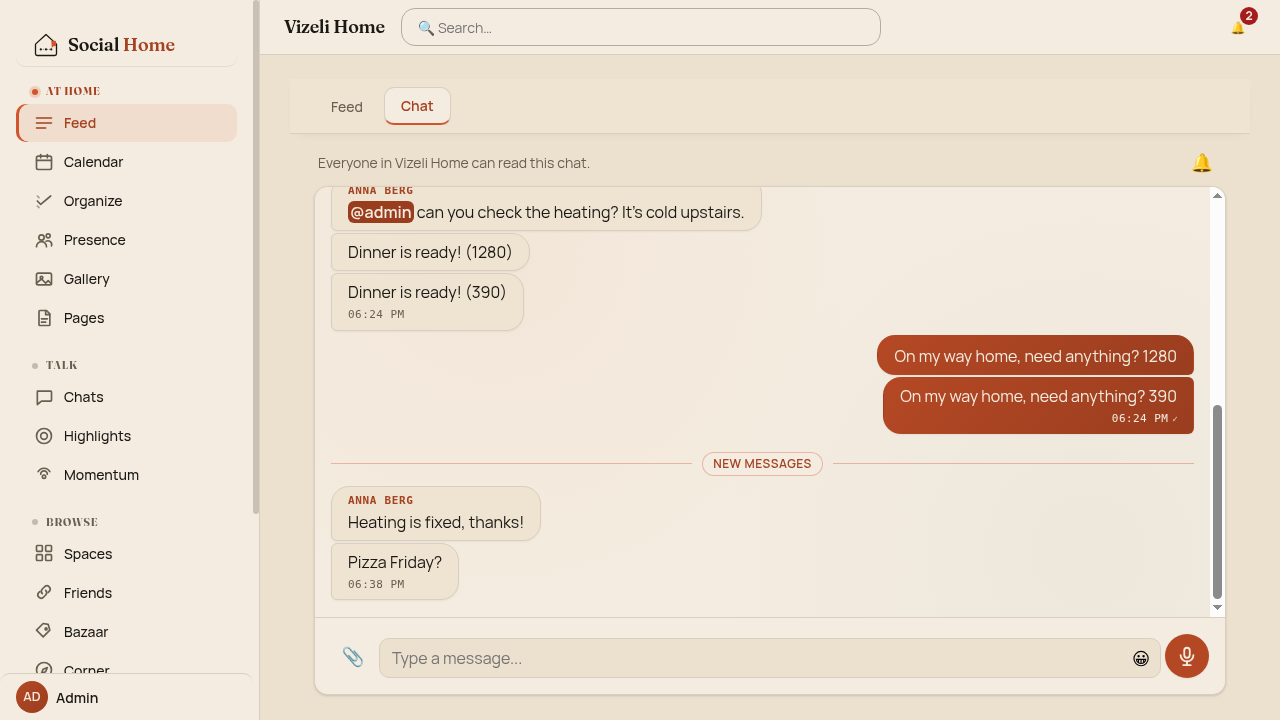
A chat for the whole household
“Dinner is ready.” “Can someone check the heating?” “Pizza Friday?” Not every message is worth a post. The feed now has a Feed | Chat switch at the top, and behind it is one chat that everyone in your household can read. It works like any group chat: @mentions, reactions, edits, attachments and a New messages line where you left off. You can mute it or only be notified when someone mentions you.
The household chat never leaves your home. It isn’t sent to paired households, and it doesn’t clutter your Chats inbox. An admin can switch it off under household settings; then the feed looks exactly as it did before.
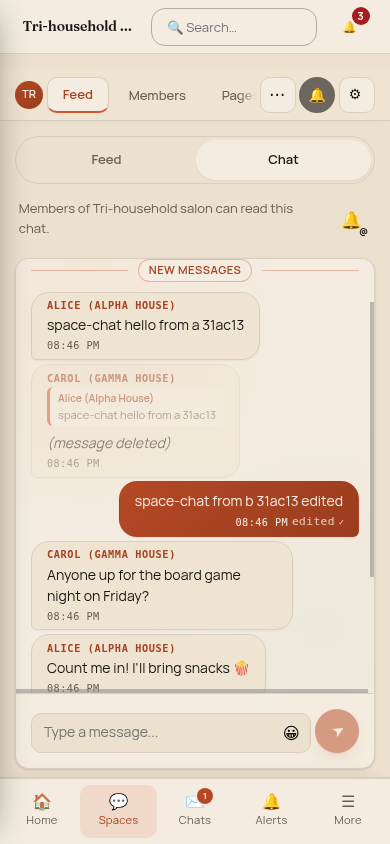
Spaces get the same switch. Every space now has a chat shared by its members across households — the book club can agree on the next date without a post for it. Followers of a space don’t see the chat and don’t receive it. By default it only notifies you when someone mentions you, the space’s moderators can remove any message, and an archived space keeps its chat readable but closed. For now space chat is text only. The owner can switch it off in the space’s settings.
Under the hood
The household chat is a regular group DM with a household scope:
it reuses messages, mentions, reactions, mute and read state, but
outbound fan-out skips it and every inbound DM_* handler refuses
its id. Space chat travels as four new federation events
(SPACE_CHAT_MESSAGE_CREATED, _UPDATED, _DELETED,
SPACE_CHAT_REACTION, protocol v55), sealed like all other space
events, and is delivered only to households holding a writer seat.
Households below v55 are skipped. New members catch up through
space sync, including deletions.
Paired households get a safety net
Paired households talk to each other directly. When that direct path fails — a router acting up, an address that changed, a household without an outside address at all — messages used to wait in the outbox until it came back.
Now you can let the GFS (Global Federation Server) step in as a fallback. It’s off by default and set per connection, under Connections → Manage. Both households have to turn it on, and their homes find a GFS they both use without telling each other which ones they’re connected to. When pairing, the new How can they reach you? choice lets a household without an outside address pair through the GFS. Once it gets an address later, the pair switches to direct by itself.
The GFS is only used when the direct path fails, and everything it carries stays sealed. It can see when and how much your two households exchange, and that you are paired — never what you say. That’s why the app keeps calling a direct address the more private choice.
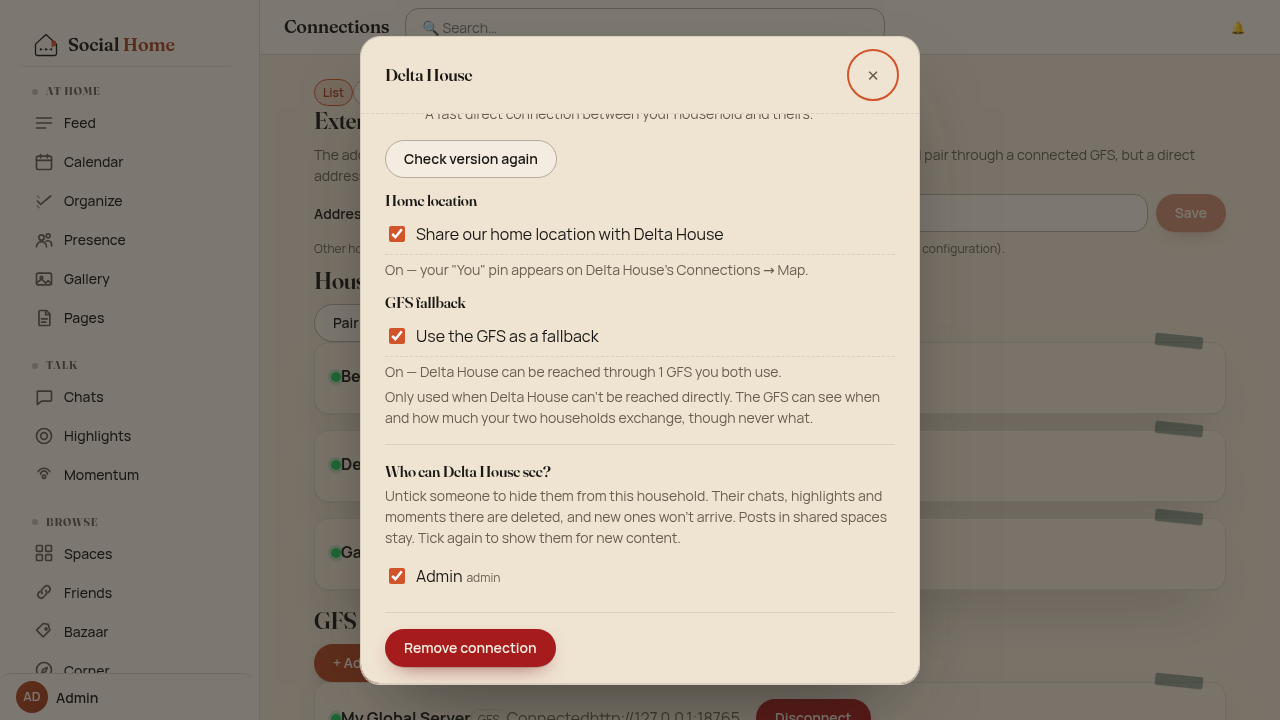
One more change on the GFS side: the welcome tour’s Connect to the GFS box now starts ticked. Untick it to stay off the GFS; you can connect or disconnect any time in Connections.
Under the hood
Paired traffic tries the WebRTC DataChannel first, then the HTTPS
inbox, and only on a network error or 5xx (or with no URL at all)
round-robins over the pair’s GFS routes. A 4xx never falls through.
The GFS only sees {to_instance, sealed}. Shared GFSes are found by
sending a nonce probe through each of our own GFS connections; a
route is recorded only when the ack comes back through the same GFS,
so a GFS replaying a probe elsewhere creates nothing. Routes are
re-probed every 24 h and expire after 72 h. Protocol v53 (routes) and
v54 (key exchange for existing pairs).
Syncs send only what changed
Every half hour, your home checks in with the other households in your spaces to make sure nobody missed anything. Until now, that meant re-sending every recent post, comment and photo record, every time. Now each household sends only what changed since the last sync the other side confirmed. A quiet space costs almost nothing.
Two things got more reliable along the way:
- Deletes reach everyone. A deleted post, comment, sticky note, event, photo or zone now reaches households that were offline when it happened, instead of quietly coming back later.
- A restored backup catches up. A household restored from an older backup gets the missing changes at the next sync, without anyone pressing Sync now.
What a sync carries is no longer cut off at fixed numbers. The space’s own retention period decides how far back it reaches.
Under the hood
SQLite triggers stamp every synced row with a per-household counter
(sync_seq), so no write path can forget. The sender keeps a
watermark per household and only advances it after a stream the
receiver reports as clean, so a failed chunk comes again next time.
A restored household echoes the last snapshot it applied
(have_seq); the sender streams from the lower of the two and never
trusts a value above its own. A full stream still runs at pairing,
on join, on Sync now, after a shape change and at least once a
day. Deletions travel as content-free tombstones and are applied with
the same authority as a live delete. No protocol bump.
Try it
The GFS fallback is in Social Home 2026.10.8; the chats and the lighter sync are in Social Home 2026.10.9. Both households need the new version for the fallback and for space chat. Want to know more about how households reach each other? Read Households, federated.